The Enneagram Is Mostly About Compassion
Nine ways of paying attention, and why the most practical thing the system offers is compassion — for the people around you and for yourself.
My mother-in-law introduced us to the Enneagram in our early 20s with a weekend away without kids. I’m pretty sure it’s the reason we’re still married. Since then I’ve studied with David Daniels, Russ Hudson, and Beatrice Chestnut and Uranio Paes at their joint workshops, teachers who disagree about plenty and agree about the thing that matters. I’ve watched the system get dismissed as Myers-Briggs for the spiritually inclined and oversold as a complete map of the human soul. Neither has much to do with how I’ve actually used it.
What I want to do here is describe what it has been good for in practice, and leave you with resources worth your time. If you want to find your type first, I built Enneagram Quick Type for a fast, adaptive assessment that gets you to a working hypothesis about your type and subtype in minutes rather than an afternoon.
Nine ways of paying attention
David Daniels taught me that the Enneagram is mostly about compassion. That sounded soft at the time. But it ended up being the most practical thing anyone has told me about the system.
The Enneagram describes nine distinct ways of paying attention. Each type is organized around a core concern, something it’s scanning for and something it’s trying to avoid, and that focus of attention shapes what gets noticed, what gets missed, and how the person responds under pressure. When my wife Mimi, a marriage and family therapist, and I introduced the system to my teammates, we used a garden to make the point. Put nine people in front of the same plot and the Eight says “I’m in charge of the garden,” the Nine puts up a hammock, the One starts pulling weeds, the Two plants vegetables to give away, the Three wants to franchise it, the Four wants it unlike any garden anyone has seen, the Five buys a gardening book before touching the soil, the Six has already researched organic pesticides, and the Seven just wants to play in it. Same garden. Nine different gardens.
Once you can see that the colleague who keeps flagging risks isn’t being negative but running a threat-detection strategy that has kept her safe her whole life, or that the friend who won’t commit to a plan isn’t flaky but protecting the open options he needs to feel free, the behavior stops being an insult aimed at you. It becomes a pattern with logic. Compassion, in this sense, isn’t a feeling you try to generate; it’s the byproduct of understanding what someone is actually doing and why.
And it runs inward first. The hardest person to extend that understanding to is yourself. Seeing your own pattern laid out, with its origins, its costs, and its real gifts, makes it much harder to keep treating your reactions as character flaws to be beaten out of you. There’s a substantial research literature on why that matters: Kristin Neff’s 2023 review in the Annual Review of Psychology summarizes decades of work showing that self-compassion is associated with better mental and physical health and greater resilience, and that it does not make people lazy or self-indulgent, and MacBeth and Gumley’s meta-analysis found a large negative association between self-compassion and symptoms of depression, anxiety, and stress. The Enneagram is one of the most reliable on-ramps to self-compassion, because it gives you a specific, non-humiliating account of what you’re up against!
Looking at the dark side without calling it a disorder
Most personality frameworks either flatter you or diagnose you. The Enneagram assumes every type has a shadow, describes it in detail, and treats it as ordinary human material rather than pathology.
Each type has a characteristic “passion”, the old word for the way a type loses its center: the emotional habit that runs the show when we’re not paying attention. Resentment for the One, pride for the Two, deceit for the Three, envy for the Four, avarice for the Five, fear for the Six, gluttony for the Seven, lust for the Eight, sloth for the Nine. Those sound like a list of sins, and historically they were, but the modern teaching treats each one as a habitual way to “miss the mark.” The Five’s avarice isn’t greed for money; it’s a withholding of the self, born of the belief that the world will drain you. The Nine’s sloth isn’t laziness (plenty of Nines are enormously productive); it’s a numbness, a desire to be unaffected by life. The Seven’s gluttony is for experience, staying full enough that the painful feelings never catch up.
And each passion has a counterpart, a virtue, which is what the type looks like when it finds its center: serenity for the One, humility for the Two, authenticity for the Three, equanimity for the Four, non-attachment for the Five, courage for the Six, sobriety for the Seven, innocence for the Eight, engagement for the Nine. The virtue isn’t a different personality. It’s the same energy, un-distorted: the Seven’s sobriety isn’t abstinence, it’s savoring what’s already here.
None of this is diagnosis. It’s a description of what a normal, functioning person does on autopilot, in their habitual pattern. Once you can catch yourself mid-pattern, you have a choice you didn’t have a second earlier.
Russ Hudson and Don Riso formalized this in their Levels of Development, a continuum within each type from healthy to average to unhealthy. Two people of the same type can look almost nothing alike depending on how identified they are with the pattern in a given season of their lives. At the healthy end, the type is a set of gifts; in the average range, where most of us live, it’s a set of compensations. The framework lets you notice which direction you’re moving without a therapist’s label attached.
Beatrice Chestnut and Uranio Paes, whose joint workshops I’ve attended and who together ran the Chestnut Paes Enneagram Academy out of Claudio Naranjo’s lineage, put the emphasis on the 27 instinctual subtypes: how each type’s passion plays out through the self-preservation, social, or one-to-one instinct. Two Sevens, one self-preservation and one social, can look like different people entirely, and the subtype often explains the behavior a person can’t square with their type description. Chestnut’s The Complete Enneagram is the most thorough treatment in English; she and Paes wrote The Enneagram Guide to Waking Up as the practical workbook.
The line Uranio uses, paraphrasing Jung, is that the only sin is to live unconsciously. That’s the whole non-pathologizing stance in a sentence. Your patterns are only a problem when you’re not seeing them.
Your type is your home base rather than a box
The most common misunderstanding, and the one that turns thoughtful people off the whole system, is that being typed means being boxed. The opposite is true if you’re using it well.
Your type is your natural orientation toward the world: what you’re built to notice, what comes easily, where your reliable strengths are. Ones really are better at seeing what needs fixing. Fives really do go deeper on a problem. Nines really can hold a group together. The Enneagram’s advice is to inhabit your own type with enough awareness that the strengths stay strengths without hardening into a rut.
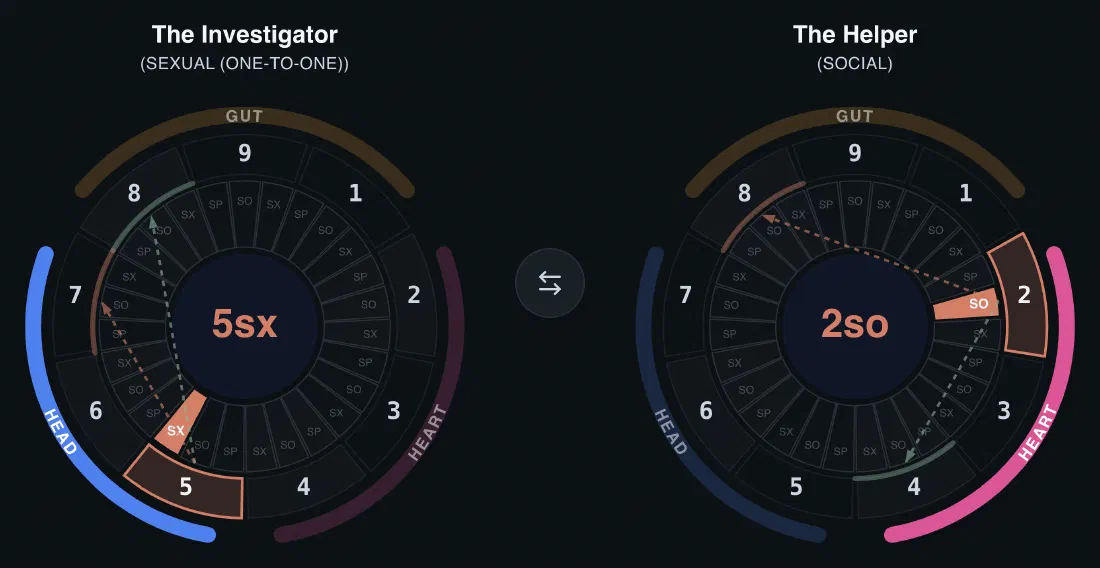
The system is also explicitly dynamic. Each type connects by lines to two others, and the traditional teaching is that under stress and in security we take on qualities of those points on the Enneagram. Whether or not you travel along the arrows literally (the research on them is thin), the practice has taught me that the healthiest people have access to the whole circle. Hudson’s later work, especially The Enneagram: Nine Gateways to Presence, frames all nine points as capacities every human being has, with your type simply the one you over-rely on. The goal was never to be a good Four. The goal is to be a whole person who happens to have the Four’s window on the world.
David Daniels built this into what he called the Universal Growth Process, a practice sequence that works the same way for every type. He taught it as “five As”. Awareness: breathe, come back into the body, notice what’s happening. Acceptance: meet the reaction with open-hearted acceptance, which doesn’t mean agreeing with it; “befriend your reactivity,” he liked to say. Appreciation: find what you’re grateful for and let the grip loosen, since most of what we’re reacting to is old material anyway. Action: choose a response instead of firing the reaction. Adherence: do it again tomorrow. It compresses to a distinction Mimi put on a slide for my team: stimulus → reaction, versus stimulus → pause → response. That pause is where freedom lives. Every contemplative tradition teaches some version of this; the Enneagram tells you specifically where to look for your own version of the reaction.
It’s useful as an exploration tool
The core type descriptions are robust enough that strangers on a panel, asked open questions about how they experience life, reliably say things that make the room laugh in recognition. That’s the Narrative Tradition Helen Palmer and David Daniels founded in 1988: you learn the types from people who have them, not from a book. The superstructure is more speculative, and you can use the system well without treating any of it as settled. The research list at the end has the studies worth reading if you want to go deeper.
The system isn’t ancient, whatever its resonance with archetypal patterns people have noticed across history. The symbol has old roots, but the nine-type psychology was developed by Oscar Ichazo in the 1960s and elaborated by Claudio Naranjo in the 1970s, as the Enneagram Institute’s own history page says.
How I suggest starting to use it
Find a working hypothesis for your type. Quick Type will get you there fast, and if you’re torn between two, its side-by-side contrast narratives are built for exactly that question. But discovery of your type happens from the inside out. No test, and no friend who’s sure they’ve got you figured out, can settle it; only you can recognize the motivation underneath the behavior. Hold the result loosely for a few weeks and watch for the pattern in the wild. Then read your type’s shadow with curiosity rather than judgement. Notice when the pattern is triggered. Just noticing is the start.
Then do the same for the people you live and work with. It helps to see the logic in what used to look like obstinacy or neediness or evasion. That’s the whole practice of compassion. Having the Enneagram as a map just helps.
Why I built Quick Type
“The only sin is to live unconsciously.” — Uranio Paes, paraphrasing Carl Jung
When we moved to San Francisco, we learned from David Daniels that the Enneagram is mostly about compassion. At work. At home. At the onramp to 101 South. The Enneagram has been such a useful tool in cultivating compassion in both me and my relationships that I was motivated to make it accessible to as many people as possible, in many languages, and without a one-day workshop standing between people and their type discovery.
I’m short-circuiting the Narrative Tradition without advocating that you skip it. Quick Type works by asking the single most differentiating question it can at each step, so it lands on a candidate type and subtype in under a minute. In the Narrative Tradition I learned from, where you spend hours listening to panels of people describe their inner lives before you dare to guess your own type, that is close to heresy. But I don’t see the harm. Nobody at a dinner party is going to sit through a panel, and plenty of people who would get real value from this system will never pick up a 400-page book to find out. Quick Type is the toe in the water. If the result rings true, you’ll know where to go next. If it doesn’t, the contrast narratives will help you figure out where else you might explore on the map.
Find your type in under a minute at Enneagram Quick Type →
Resources
Start here
- The Wisdom of the Enneagram by Don Richard Riso and Russ Hudson — If you read one book, read this one. Full type descriptions, the Levels of Development, and practical growth work for each type.
Teachers and schools
- David N. Daniels, MD — Stanford psychiatrist, co-founder of The Narrative Enneagram and the International Enneagram Association. Site includes his articles, type descriptions, and the Stanford Enneagram Test and Guide. His book with Virginia Price, The Essential Enneagram, is the best short introduction.
- The Narrative Enneagram — The school Helen Palmer and David Daniels founded; panel-based training where you learn each type from people who have it.
- Russ Hudson and The Enneagram Institute — Home of the Riso-Hudson tradition, the Levels of Development, and detailed type pages. Hudson’s Nine Gateways to Presence is his more contemplative recent work.
- Chestnut Paes Enneagram Academy — Uranio Paes and Beatrice Chestnut’s school, rooted in Naranjo’s lineage with a strong emphasis on the 27 subtypes. Their Enneagram 2.0 podcast is a good free entry point. Books: The Complete Enneagram and The Enneagram Guide to Waking Up.
- International Enneagram Association and IEA Nine Points — Professional association and its archive of journal articles and conference material.
Research
- Hook, J. N., Hall, T. W., Davis, D. E., Van Tongeren, D. R., & Conner, M. (2021). The Enneagram: A systematic review of the literature and directions for future research. Journal of Clinical Psychology. The essential starting point for anyone who wants an evenhanded read on the evidence.
- Sutton, A. (2012). “But Is It Real?” A Review of Research on the Enneagram. Enneagram Journal, 5(1). Also Sutton et al. (2013) on type and work outcomes, and Sutton (2015) on self-awareness training.
- Newgent, R. A., et al. (2004). The Riso-Hudson Enneagram Type Indicator: Estimates of Reliability and Validity. Measurement and Evaluation in Counseling and Development.
- Wagner, J. — WEPSS, the Wagner Enneagram Personality Style Scales, one of the few instruments with published psychometric validation.
- Enneagram typologies and healthy personality to psychosocial stress: A network approach (2022). Frontiers in Psychology.
- Neff, K. D. (2023). Self-Compassion: Theory, Method, Research, and Intervention. Annual Review of Psychology. Not about the Enneagram, but the best summary of why self-compassion is worth cultivating.
- MacBeth, A., & Gumley, A. (2012). Exploring compassion: A meta-analysis of the association between self-compassion and psychopathology. Clinical Psychology Review.
History and context
- The Traditional Enneagram — The Enneagram Institute’s clear account of the system’s actual origins with Ichazo and Naranjo.
- Claudio Naranjo and Oscar Ichazo — Background on the two figures who turned the symbol into a psychology.
Tools
- Enneagram Quick Type — Fast adaptive typing with subtype, contrast narratives for people torn between two types, and relationship and work dynamics. Available in 31 languages.