The Stories We Tell Our Kids
The stories we tell our children are the architecture of their inner lives.
My dad is a natural storyteller.
My grandfather arrived at Ellis Island at age 13 and sold umbrellas on the sidewalks of New York City alongside his father, a fruit peddler. My great-uncle repaired tires, then radiators, and eventually ran a local general store. My dad traveled alone by train through Grand Central Station as a young kid to work in their shop during the summers.
As I grew up, these stories gave me a sense that I was part of something larger than myself.
The same facts could have been framed around hardship, isolation, and uncertainty. Instead, my dad passed them down as stories of sacrifice, resilience, humor, and hope.
Watching my young grandchildren process their own world has made me think about this differently. Their stories are smaller—“I cried at preschool,” “the birthday candle was too big,” a funny thing that happened on a trip—but they return to them again and again.
They frequently ask us to reread books about things that happened to them, seemingly eager to make sense of those experiences. They’ll even climb out of a kiddie pool on a hot day to hear a new one.
One of their favorite read-alouds is Mercer Mayer’s Liza Lou and the Yeller Belly Swamp. I always read it fully in character, and it brings back my own childhood days exploring creeks in rural Virginia, where snakes and abandoned houses could make an ordinary afternoon feel like an adventure.
It sparked a simple realization: I wanted to capture our own family history and everyday lore in beautiful picture books designed specifically for them.
That motivation led me to start building KinMuse—a tool to help parents and grandparents turn real family moments into illustrated read-aloud storybooks.
A story gives an experience shape
At a mindfulness retreat with Ron Siegel in Costa Rica, I had an experience that stayed with me. Before our first bite of dinner, we sat with our eyes closed while Dr. Siegel narrated the journey of the rice in front of us: photons traveling 8 minutes from the sun to reach a paddy, months of rain and cultivation, the harvest, transportation, the chef steaming it, the seasoning, and finally the staff placing the dish before us. That first bite tasted sooo good. Nothing about the rice itself had changed. The story around it had changed my attention to it.
I’ve come to think family stories work in a related way. They don’t change the facts of an experience, but they can give those facts shape. They create a way to revisit something, talk about it, laugh about it, and carry it forward. The meaning we create and emphasize matters.
A family story about getting lost can become a story about finding the way back. A story about something going wrong can become a story about how everyone adapted. A difficult chapter in a family history can be remembered not only for the hardship involved, but also for the persistence, humor, sacrifice, or love inside it. Without changing what happened, we can decide what we want to notice and remember about it.
Reading aloud is where it starts
Reading together gives young children an extraordinary amount of exposure to language. One widely cited 2019 Ohio State study estimated that a child read five books a day would hear about 1.4 million more words by kindergarten than a child who was never read to.
But the part I care about most isn’t simply the number of words. It’s the interaction around them. A child sits close to someone they trust. They point at a picture. They interrupt. They ask a question. They laugh at the same part for the twentieth time. The story becomes something shared. That shared conversation is where family storytelling becomes especially interesting.
A story is one way a child makes sense of the world
Psychologists have studied what they call reminiscing: the way parents and young children talk together about things that have already happened. Robyn Fivush and her colleagues have found that the style of these conversations matters. When parents revisit shared experiences with detail, questions, and emotional awareness, children tend to develop richer autobiographical narratives, stronger self-understanding, and better emotion regulation.
In other words, putting words and structure around an experience can help a child make sense of it. I see a tiny version of this continually with my granddaughters. Returning to the same family story gives them a place to revisit an experience at their own pace—acting out parts of it, laughing, asking questions, and sometimes changing which details seem important to them. One of them reenacts “I cried at the dentist” by lying back on the sofa and brushing her teeth. The story hasn’t erased the experience. It has made it something she can return to and play with.
Some stories need to be heard fifty times
In one of our family books, The Big Canoe Goodbye, a road closure in Maine forces the family to take a canoe to reach the airport. For the adults, it was a minor travel hiccup. For a small child, it was an adventure. The line the whole book turns on is:
“The water is our road today.”
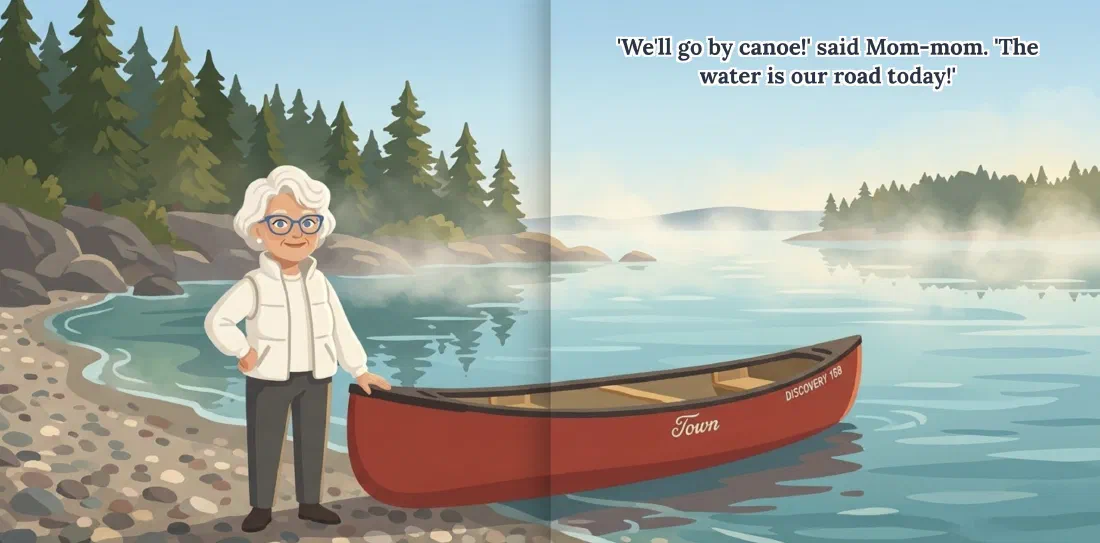
That line gives us a simple way to talk about adaptability: sometimes the road closes, and we find another way.
Same trip, fifty different chances to hear it. In every retelling, the road closes. The grown-ups find another way. Everyone gets home.
That repetition may be one of the most useful things about turning a real memory into a book. An experience that might otherwise disappear into the blur of childhood becomes something a family can return to again and again.
Knowing where we come from
Family stories also help answer a larger question: Where do I come from? Researchers at Emory University have found that children who knew more about their family histories tended to show higher self-esteem and stronger coping. The researchers described an “intergenerational self”—a sense that you belong to something larger than yourself.
Those children were school-age rather than toddlers, and the finding is correlational rather than proof that knowing family stories causes resilience. Still, the idea resonates with what many families already do intuitively.
It isn’t about memorizing dates or constructing a formal genealogy. It’s about hearing how your grandparents met. Why someone moved across the country. The summer your dad worked in the family shop. The vacation when everything went wrong. The funny thing your mother always said.
The Emory researchers also cite work suggesting that family storytelling starts remarkably early. Parents tell stories to infants long before those children can understand or retell them. We don’t wait until our kids are old enough to understand the NYC umbrella-sales story. We just start telling it.
Personalization invites children in
There’s also some early research suggesting that young children respond differently when the story is specifically about them.
In one small home-based study, Natalia Kucirkova and colleagues found that toddlers and their parents smiled and laughed more while sharing a personalized book than a comparable book without the personal details, and were more vocally engaged with it than with the child’s own favorite book.
It was a very small study—just seven families—and it can’t establish cause and effect. But it points toward something parents already recognize: young children pay close attention to things that feel familiar—their people, their pets, their places, their routines. Seeing those inside a book creates an immediate invitation into the story.
You don’t need a tool to start
Pick a small moment—a trip, a funny mishap, an old memory—and tell it aloud.
Let your child interrupt. Let them ask questions. Let them correct you. Let them focus on a detail you thought was completely unimportant. Then tell it again tomorrow. The conversation is the important part. When a story becomes a favorite, turning it into a book gives the family another way to revisit it. That’s what I wanted KinMuse to make easier.
Why I’m building KinMuse
KinMuse uses AI to help turn your memories, photos, and notes into a story designed to be read aloud.
You remain the author. The AI can help shape the language and keep illustrations visually consistent from page to page, but the heart of every book comes from you: your memories, your voice, your family, and the meaning you choose to give the story.
The storybook isn’t the source of a child’s connection, vocabulary, belonging, or resilience. Parents and grandparents are. The goal is simply to make it easier to preserve some of the stories families are already telling by turning them into storybooks.
You can start a story for free, draft the whole thing, and preview the first few illustrated pages before deciding whether you want to complete the book. And because these stories can be deeply personal, privacy matters: your family’s photos and stories aren’t used by KinMuse or its AI providers to train their models.
It’s still early, and I’d genuinely love feedback from families who try it. If there’s a story waiting to be told in your family, I hope you’ll start with the simplest version: tell it tonight. And if it becomes one your child wants to hear fifty times, KinMuse is there to help you keep it.